
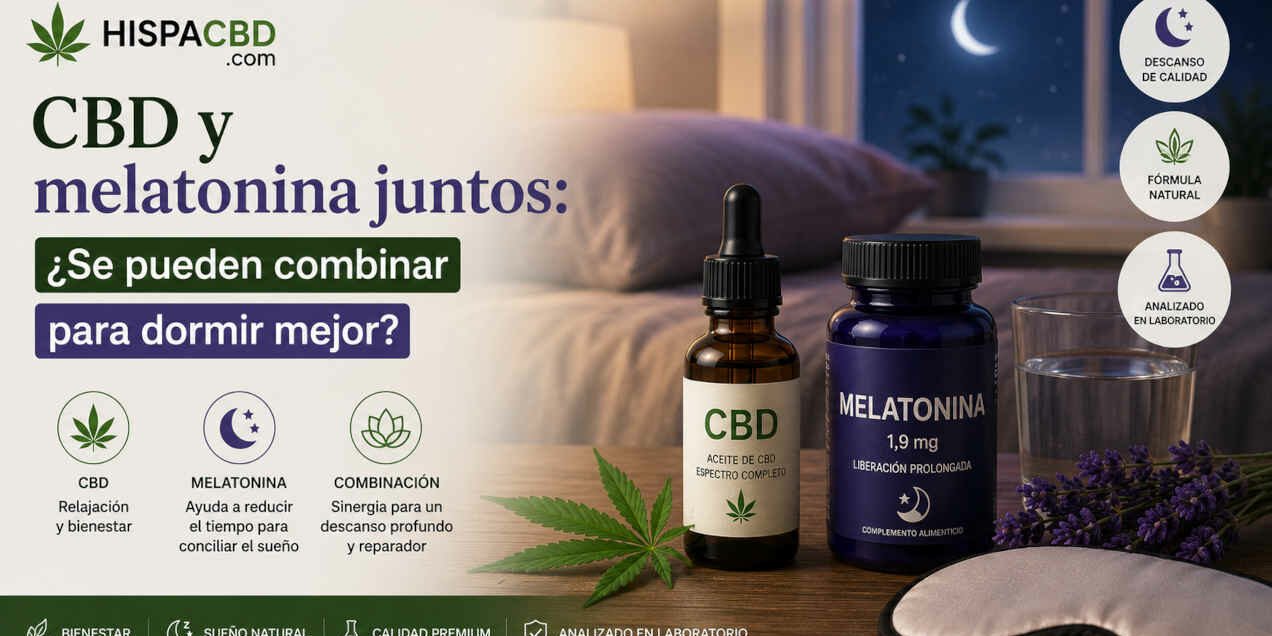
More and more people are turning to the combination of CBD and melatonin as a natural alternative to improve their sleep. This is no coincidence: insomnia and sleep problems affect millions of people in Spain, and the search for solutions that don't involve conventional medication has sparked interest in these two substances.
But can they really be taken together? Is it safe? And do they work better in combination than separately? In this article, we explain everything, with scientific backing and no beating around the bush.
The problem of sleep: more complex than it seems
Before discussing solutions, it's worth understanding the problem. When someone says they "sleep poorly," they may be describing very different situations:
- Difficulty To fall asleepThe mind doesn't stop; thoughts race when the head hits the pillow.
- Awakenings questions during the night, for no apparent reason.
- Wake up too early without being able to sleep again.
- A seemingly complete dream, but non-repairableEight hours in bed and you wake up exhausted.
- Circadian rhythm maladjustedYou go to bed late, you have trouble getting up, your schedule has shifted.
This distinction is crucial because CBD and melatonin don't work the same way or address the same issues. Understanding your sleep pattern will help you determine which of the two—or if both—might be more beneficial for you.
What is melatonin and how does it work?
Melatonin is a hormone naturally produced by the pineal gland , a small structure located in the brain. Its synthesis is regulated by the light-dark cycle: when the sun sets and darkness increases, the brain—through the hypothalamus and the suprachiasmatic nucleus—activates the production of melatonin, which is released into the bloodstream as a signal that "it is nighttime" and that the body should prepare for sleep.
In other words, melatonin doesn't directly "make you sleepy," but rather regulates the biological clock . Its main function is to synchronize the circadian rhythm, that approximately 24-hour cycle that governs when we are sleepy, when we are alert, when our body temperature rises or falls, and many other physiological functions.
Melatonin levels peak between 2 and 4 a.m. and drop rapidly with the arrival of morning light. From the age of 40-45, the body's natural melatonin production begins to decline gradually, which partially explains why sleep disorders are more common in middle-aged and older adults.
When does supplemental melatonin help? Primarily in situations of circadian rhythm disruption : jet lag, shift work, difficulty falling asleep due to delayed sleep schedule, or simply when endogenous production has decreased with age.
Its limitations: Melatonin doesn't address the emotional or physical causes of insomnia. If you can't sleep because of anxiety, pain, or a racing mind, melatonin alone may not be enough.
What is CBD and how can it help with sleep?
CBD (cannabidiol) is a natural cannabinoid extracted from industrial hemp. Unlike THC, it is not psychoactive and does not produce euphoria or altered consciousness. It acts primarily on the endocannabinoid system , a network of receptors distributed throughout the body that regulates essential functions such as mood, pain response, inflammation, and sleep.
The mechanism by which CBD can improve sleep is not direct: CBD does not act as a sleeping pill that "switches off" the nervous system. Its contribution to sleep is rather indirect , through several channels:
Anxiety and stress reduction. CBD interacts with serotonin receptors (5-HT1A), modulating the stress response and reducing anxiety activation. When the nervous system is in "alert" mode at night, falling asleep becomes nearly impossible. By reducing this activation, CBD can facilitate the transition to rest. A study published in The Permanente Journal (2019) with 72 patients found that 79,2% of participants reported a reduction in anxiety and 66,7% experienced improved sleep quality within the first month.
Reduction of nighttime cortisol. CBD can help reduce cortisol levels (the stress hormone), which in people with insomnia tend to remain elevated at night when they should be at their lowest. Lower cortisol levels promote a physiological state conducive to rest.
Pain relief. Chronic pain is one of the most frequent causes of disrupted sleep. By modulating pain perception through TRPV1 and CB2 receptors, CBD can reduce sleep disruptions caused by physical discomfort.
Modulation of REM sleep. Preliminary research suggests that CBD may influence sleep architecture, especially in people with disorders such as PTSD (post-traumatic stress disorder) that affect the REM phase.
CBD vs. melatonin: which is better for sleep?
It's not about choosing one or the other, but about understanding what each one is for:
| melatonin | CBD | |
|---|---|---|
| Mechanism | It regulates the biological clock (circadian rhythm) | Reduces anxiety, cortisol, and pain |
| Ideal for | Jet lag, shift work, delayed pace | Insomnia due to stress, anxiety, or pain |
| Speed of action | Quick (30-60 min) | Variable (sublingual: 15-45 min) |
| Direct effect on sleep | Yes, it shortens the time it takes to fall asleep. | Indirect (acts on the causes) |
| Dependency risk | No, but it can create a psychological habit. | Not known |
The key difference lies in the mechanism of action : melatonin acts directly as a chronobiological signal, telling the body it's time to sleep. CBD acts on the obstacles that prevent sleep: accumulated tension, repetitive thoughts, pain, and high cortisol levels.
Can CBD and melatonin be combined? What does science say?
The answer is yes , and physiological logic supports their combination. By acting through completely different and complementary mechanisms, CBD and melatonin do not interfere with each other and can work in parallel on different aspects of insomnia.
Melatonin activates the biological clock and signals that it's time to sleep. CBD reduces nervous system activation, anxiety, and physical tension that would otherwise prevent this signal from working properly. They're two pieces that fit together: one tells the body "it's nighttime," the other tells the nervous system "you can relax."
A clinical study conducted by Radicle Science specifically evaluated the combination of CBD and melatonin versus the use of melatonin alone, finding that participants taking both compounds reported significant improvements in sleep duration and quality compared to the group taking only melatonin.
Furthermore, a study by the Complutense University of Madrid , developed in collaboration with the company Phexia, explored the effects of CBD combined with melatonin on rest and general well-being, concluding positive results on sleep quality and other health indicators.
It's important to be honest: research on this specific combination remains limited, and the available studies have modest sample sizes. Large-scale, robust clinical evidence is not yet available. However, the mechanisms of action are sound, the safety of both substances individually is well-documented, and preliminary evidence points in a positive direction.
Is it safe to take CBD and melatonin together?
In general, yes . No adverse interactions are known between CBD and melatonin when taken at usual doses. Both substances have well-established short- and medium-term safety profiles.
Some nuances to keep in mind:
Additive effect on drowsiness. Both substances can increase the feeling of relaxation and sleepiness. Although this is precisely what is desired before bed, it is advisable to take this combination only when going to bed and to avoid driving or performing activities that require concentration after taking it.
Drug interactions. This is the most important point. CBD inhibits certain enzymes in the liver's cytochrome P450 system, which are responsible for metabolizing many medications. If you regularly take anticoagulants, antiepileptics, antidepressants, anxiolytics, or other medications, always consult your doctor before adding CBD to your routine . Melatonin can also interact with anticoagulants and some immunosuppressants.
Melatonin dosage: less is more.** Although commercial melatonin supplements typically contain between 2 and 10 mg, scientific evidence suggests that much lower doses—between 0,5 and 1 mg—are often just as effective as higher doses and have fewer next-day side effects (morning sleepiness, a “hangover” feeling). The body is very sensitive to melatonin, and more doesn’t always mean better results.
Pregnancy and breastfeeding: The use of CBD or melatonin without medical supervision is not recommended during pregnancy or breastfeeding.
How and when to take CBD with melatonin?
If you decide to try this combination, here are some practical guidelines:
Timing: The key is to take both substances between 30 and 60 minutes before bedtime . Melatonin needs that time to start working. Sublingual CBD oil also reaches its peak effect between 30 and 90 minutes after ingestion.
Indicative starting point doses:
- CBD: Between 15 and 30 mg is a typical range for nighttime use, although the appropriate dose varies considerably from person to person. It's best to start with low doses (10-15 mg) and adjust according to your response.
- Melatonin: Between 0,5 and 1 mg is usually sufficient for most adults. Avoid exceeding 2-3 mg without medical advice.
How to take CBD: Sublingual oil is the most recommended option for nighttime use, due to its balance between speed of action (15-45 minutes) and duration of effect (4-8 hours). Capsules take longer to take effect (1-2 hours) but can be convenient if you prefer to take them with dinner.
Consistency: The effects of CBD on sleep tend to accumulate with regular use over days or weeks. Don't expect dramatic results on the first night; give it at least 2-3 weeks of consistent use before assessing its effectiveness.
Sleep hygiene routine: neither CBD nor melatonin are magic solutions if the environment isn't supportive. Reducing exposure to blue light screens before bed, keeping the bedroom cool, avoiding caffeine after midday, and maintaining a regular sleep schedule are all factors that enhance the effect of any sleep supplement.
For whom might this combination be especially useful?
The combination of CBD and melatonin may be particularly interesting for:
- People with insomnia of falling asleep related to everyday stress or anxiety.
- Those who have the shifted circadian rhythm (They sleep late, they find it hard to get up early).
- People 45 over years whose natural melatonin production has decreased.
- Those who suffer muscle or joint pain that interrupt sleep.
- People with irregular work rhythms or who travel frequently (jet lag).
- Those who have tried melatonin alone without satisfactory results.
It is not the most suitable solution for insomnia of serious medical or psychiatric origin (sleep apnea, chronic severe insomnia, major depression). In these cases, evaluation and treatment by a specialist is essential.
Conclusion
CBD and melatonin are two complementary substances that can be safely combined to improve sleep. While melatonin synchronizes the biological clock and signals the arrival of night, CBD acts on the factors that prevent deep, restorative sleep: accumulated stress, anxiety, elevated cortisol, and physical discomfort.
Scientific evidence regarding their combination is promising, although still limited. What is clear is that their mechanisms of action are distinct and complementary, that there is no known incompatibility between them, and that for many people they represent a valuable natural alternative to conventional sleep aids.
As always, product quality is just as important as dosage. At HispaCBD, you'll find CBD oils with laboratory analysis certificates, verified concentration, and THC levels below 0,2%. We offer shipping throughout Spain in 24-48 hours and personalized support via WhatsApp if you need guidance on which product might be best for you.
Disclaimer: This article is for informational purposes only and does not constitute medical or therapeutic advice. Always consult a healthcare professional before starting any supplementation, especially if you are taking medication or have pre-existing health conditions.
Frequently asked questions (FAQ)
When will I start noticing the effects if I take CBD and melatonin together? Melatonin usually takes effect within 30-60 minutes. Sublingual CBD takes between 15 and 45 minutes. If you take them at approximately the same time before bed, they should both take effect simultaneously. The effects of CBD on sleep may take several days or weeks of regular use to become fully apparent.
Can taking CBD and melatonin every night lead to dependence? There is no known physical dependence or withdrawal syndrome associated with CBD. With melatonin, there is no pharmacological dependence, but a psychological habit can develop, and with prolonged use of high doses, the body may reduce its natural production. Therefore, it is recommended to use the lowest effective dose and take regular breaks.
Can I take CBD and melatonin if I'm already taking sleep medication? Not without first consulting your doctor. CBD can interfere with the metabolism of several medications, and combining different substances with a sedative effect can unpredictably potentiate their effects.
Are there products that combine CBD and melatonin in a single formula? Yes, there are oils and capsules on the market that combine both substances. They are convenient, although they have the disadvantage that you can't adjust the dosage of each component independently. Starting with separate products can give you more control to find the ideal combination.
Can CBD alone, without melatonin, improve sleep? Yes, especially when insomnia is related to stress, anxiety, or pain. For people with a disrupted circadian rhythm, melatonin may be more effective as a starting point. Combining both is particularly beneficial when multiple factors are involved in sleep problems.