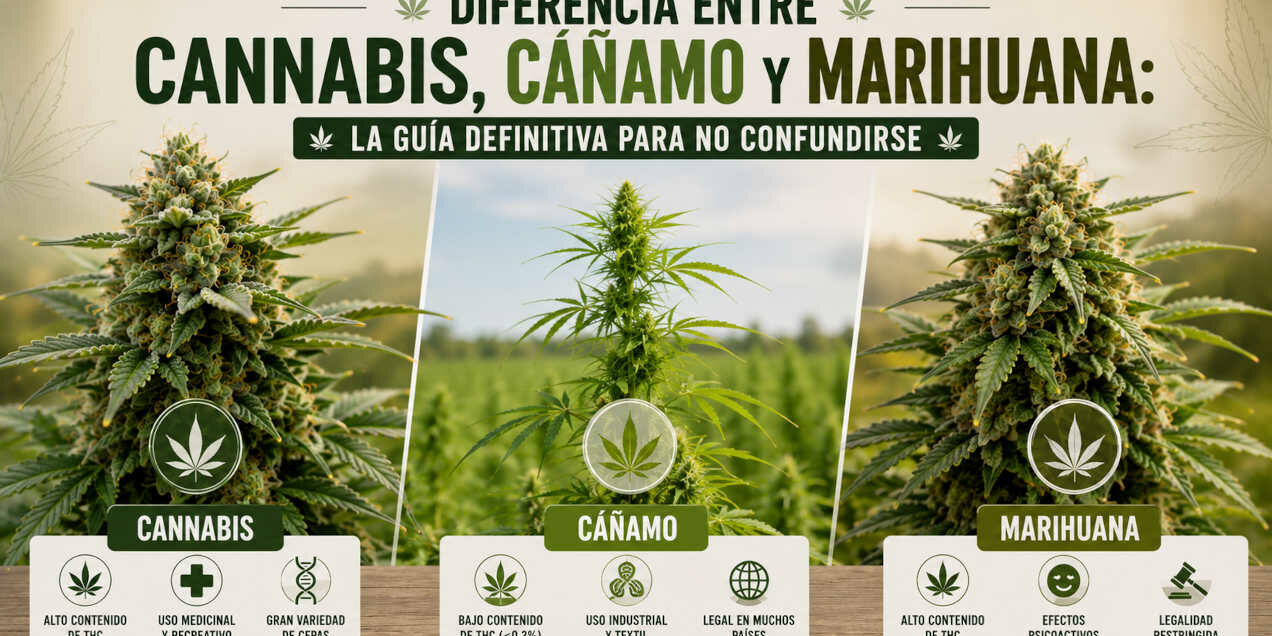
The world of cannabis is full of terms that are often mistakenly used interchangeably. In everyday conversations, in the media, and even on product labels, it's quite common to hear the words cannabis, hemp, and marijuana mixed together as if they meant exactly the same thing.
However, if you're interested in the world of wellness, CBD, legislation, or botany, conflating these concepts is a serious mistake. Although they belong to the same family, hemp and marijuana are not the same plant , and cannabis is a much broader term than most people realize.
Why is hemp oil sold freely in supermarkets while marijuana is strictly regulated? Is CBD a derivative of marijuana or hemp? What does science and the law say about this?
In this definitive guide we will break down, without absurd technicalities but with total scientific and legal rigor, the real differences between cannabis, hemp and marijuana so that you will never doubt again.
1. Cannabis: The Family Tree (The Mother of Everything)
To understand the differences, we must begin with botanical taxonomy. The term cannabis does not refer to a specific plant that you buy over the counter; it refers to an entire genus of plants belonging to the Cannabaceae family.
Let's think of it with a simple analogy: the genus Cannabis is the equivalent of the genus Citrus . Within citrus fruits, you have lemons, oranges, limes, and grapefruits. They are all citrus fruits, sharing genetic and chemical traits, but their flavor, shape, composition, and uses are radically different.
The same applies to cannabis. When we use the word "cannabis," we are referring to the umbrella term that encompasses all species, varieties, and strains of this plant, regardless of their use or chemical composition.
The three main species of Cannabis
Within the genus Cannabis, botanists primarily recognize three species (or subspecies, depending on current scientific debate):
- Cannabis Sativa: Native to tropical regions (Central America, South America, and Asia). These are tall, slender plants with fine-leafed leaves and long flowering cycles. Historically associated with more energetic and cerebral effects.
- Cannabis Indica: Native to mountainous and humid regions (Central Asia, India, Pakistan). These are shorter, robust, shrub-like plants with broad leaves. Traditionally associated with relaxing and physical effects.
- Cannabis Ruderalis: Native to cold climates (Russia, Siberia), these tiny, very hardy plants have very low levels of cannabinoids. Their most distinctive characteristic is that they are autoflowering (flowering based on age, not light cycle), which is why they are used in laboratories for genetic crossbreeding with Sativas and Indicas.
Conclusion: Cannabis is the botanical genus. Both hemp and marijuana belong to the genus Cannabis. Therefore, all hemp is cannabis and all marijuana is cannabis , but not all cannabis is marijuana or hemp.
2. Hemp: The industrial and welfare giant
Hemp is a specific variety of the Cannabis sativa species . Throughout human history (for over 10.000 years), humans have selected and cultivated hemp for its industrial, textile, and nutritional properties.
Physical characteristics of hemp
If you visit an industrial hemp field, you'll immediately notice that it looks nothing like the marijuana plants you see in movies:
- They are extremely tall plants (they can reach between 2 and 5 meters in height).
- Its stem is thick, fibrous, and very rigid.
- They grow very close together, forming dense fields similar to those of corn or bamboo.
- They barely develop side branches or large flowers, as the plant concentrates all its energy on stretching the stem.
                  ┌──> CÁÑAMO (Uso industrial/CBD - Bajo THC <0.3%)
                  │
GÉNERO CANNABIS ──┼──> MARIHUANA (Uso recreativo/médico - Alto THC)
                  │
                  └──> OTROS CANNABINOIDES (CBG, CBN, etc.)
Chemical Composition: The secret of 0,3% THC
This is the most important factor and the one that legally defines hemp worldwide. Hemp is a cannabis plant that has been modified and selected to have virtually nonexistent amounts of THC (tetrahydrocannabinol) , the psychoactive compound that produces the "high."
In the European Union and the United States, the legal threshold separating hemp from marijuana is set at 0,3% THC by dry weight . If a cannabis plant has 0,29% THC, it is considered legal industrial hemp. If it exceeds 0,31%, it automatically falls into the category of narcotic or marijuana.
In contrast, hemp is naturally very rich in CBD (cannabidiol) and other non-psychoactive cannabinoids. CBD oil, muscle creams, cosmetics, and the CBD flowers we buy in specialty stores are extracted from hemp flowers.
Main uses of hemp
Hemp is one of the most versatile plants on the planet. Absolutely every part of it can be used:
- Stem fiber: It is used to manufacture high-strength textiles (clothing, ropes, boat sails), bioplastics, insulating materials for construction (hempcrete) and high-quality paper.
- Seeds and seed oil (Hemp Seed Oil): Hemp seeds are a superfood rich in protein, omega-3 and omega-6 fatty acids, and amino acids. Culinary hemp oil is extracted from them (note: this oil does not contain cannabinoids; it is extracted by cold-pressing the seeds, not the flowers).
- Flowers and leaves: They are used for the extraction of CBD and biomass for therapeutic products.
3. Marijuana: The queen of psychoactivity and medicine
On the other hand, marijuana is the popular and commercial term used to classify cannabis varieties specifically modified to produce high concentrations of THC . Unlike hemp, the historical goal of marijuana cultivation has been to enhance its psychoactive properties, whether for recreational, spiritual, or medicinal purposes.
Physical characteristics of Marijuana
Visually, a marijuana plant is radically different from industrial hemp:
- They are noticeably shorter, more robust, and shrub-like plants.
- They have a large number of side branches.
- Its main objective is to produce buds (female flowers) large, dense, and covered by a thick layer of sticky resin. This resin is produced by the trichomes, which is where the cannabinoids and terpenes (responsible for the characteristic smell of each variety) are concentrated.
- They are grown with plenty of space between them so that light penetrates well to all the branches.
Chemical Composition of Marijuana
While hemp has a strict limit of 0,3% THC, marijuana consumed today in dispensaries or on the legal market in countries like Canada or the US typically has THC levels ranging from 15% to 30%.
This very high concentration of THC is what generates the psychotropic effects by altering perception, mood, short-term memory and coordination, by interacting directly with the CB1 receptors in the brain.
However, marijuana also contains CBD, terpenes, and more than one hundred different cannabinoids that work together through the so-called entourage effect to modulate the experience and enhance medical applications.
Main uses of marijuana
- Recreational Use: Consumption focused on leisure, relaxation, socialization or introspection through combustion, vaporization or ingestion of edibles (edibles).
- Medical Use / Therapeutic Cannabis: Used under medical supervision to treat the symptoms of serious illnesses. The combined THC and CBD from marijuana are prescribed to relieve chronic pain, nausea caused by chemotherapy, spasticity in multiple sclerosis, glaucoma, or to stimulate appetite in patients with HIV.
4. Direct Comparison: Hemp vs. Marijuana
To summarize and solidify the concepts, let's analyze the key differences in this comparison table:
| Feature | Hemp | Marijuana |
| Botanical Definition | Variety of Cannabis sativa | Variety of Cannabis sativa / Indicates |
| THC level | Virtually zero (Less than 0,3%) | High (Between 15% and 30%) |
| CBD level | Naturally tall | Variable (usually low, except for medicinal strains) |
| Physical appearance | Tall (up to 5m), fibrous stem, few leaves | Low, bushy, with dense, resinous buds |
| Type of crop | Dense outdoor fields (like wheat) | Spacing, very controlled (greenhouses or indoor) |
| Psychoactive Effect | No (It does not produce mental alteration) | Yes (Produces the classic "high") |
| Legal Status in Spain | Legal (for industrial, technical or cosmetic use) | Illegal for over-the-counter commercial sale |
| Derived products | Clothing, paper, biofuels, CBD supplements | Recreational flowers, medical THC extracts |
5. The origin of the confusion: CBD in the gray area
If hemp is legal and marijuana is regulated, why is there so much confusion surrounding CBD?
CBD (Cannabidiol) is a chemical compound found in both hemp and marijuana. However, extracting CBD from a marijuana plant would be legally pointless in most countries, as the final product would contain high levels of THC, making it illegal.
That's why 99% of the CBD products you buy in online stores come from industrial hemp.
The myth of marijuana oil vs. hemp oil
This is one of the most confusing business mistakes for users on mass-market platforms (such as Amazon, where policies prohibit the sale of cannabinoids):
- Hemp Seed Oil: It is extracted by pressing hemp seeds. It is an excellent nutritional oil, rich in fatty acids, but It contains no CBD or THCIt's the one you usually see listed in cosmetics at large stores or supermarkets.
- CBD Oil: It is extracted from the flowers (buds) of industrial hemp plants. It contains high levels of cannabidiol and is used for relaxation, pain relief, or anxiety.
- Marijuana Oil (THC Oil): It is extracted from the flowers of the marijuana plant. It contains high doses of THC and is used for recreational or serious medical purposes in countries where it is regulated.
6. Current Legal Situation: What is legal and what is not?
Cannabis legislation is constantly changing, but the distinction between hemp and marijuana follows a clear international logic:
In Spain and the European Union
- Industrial hemp is 100% legal provided the seed variety is registered in the European Union catalog and its THC levels remain below 0,3%. Farmers can cultivate it for fiber, seeds, or biomass.
- CBD products (flowers, resins, oils) derived from hemp are legally sold under free trade regulations, although in Spain their regulation prohibits labeling for direct human consumption (they are marketed for “external use”, “collecting” or “cosmetics”).
- Marijuana (with high THC) is illegal for open commercial sale. Private cultivation in private spaces is in a decriminalized zone (self-consumption) as long as it is not visible to the public or intended for trafficking substances.
7. Frequently Asked Questions (FAQ)
Are hemp and cannabis the same thing?
Hemp is a type of cannabis, but cannabis also includes marijuana. Saying hemp and cannabis are the same thing is like saying a poodle and a wolf are the same because they're both canines. Hemp is an industrially specialized form of cannabis.
Can industrial hemp be smoked?
Industrial hemp flowers (popularly known as CBD flowers) can be smoked or vaped in countries where their use is regulated. They will not produce any psychoactive or intoxicating effects due to their lack of THC, but they do provide the relaxing and analgesic effects of CBD.
If I test positive on a drug test, could it be because of hemp/CBD?
Full-spectrum CBD oils and flowers contain legal traces of THC (<0,3%). Although highly unlikely, heavy, daily use of these products could lead to an accumulation of THC metabolites in the body and cause a false positive on highly sensitive urine tests. If you are subject to routine drug testing, it is recommended to use CBD isolate or broad-spectrum products (thm-free).
Conclusion: The importance of speaking properly
Differentiating between cannabis, hemp, and marijuana is not a matter of mere linguistic pedantry; it is a necessity in a globalized market that is moving towards regulation.
Knowing that cannabis is the family, hemp is the industrial and wellness ally free of psychoactive effects, and marijuana is the THC-rich variety focused on medicine and recreation, will allow you to buy consciously, understand the laws of your country, and take advantage of the benefits of this ancient plant with complete safety.
When you next buy CBD products, remember to always check the lab results. Only then can you be sure that what you're buying comes from a clean, safe, and 100% legal hemp crop.