One of the most frequent questions among those who start using CBD is this: how long do I have to wait to notice something? And the honest answer is that it depends, above all, on how you are taking it.
Placing a few drops of oil under your tongue is not the same as taking a capsule or applying a cream to a painful area. Each method of consumption has a completely different absorption rate, bioavailability, and duration of effect. Understanding these differences is key to using CBD effectively and avoiding frustration.
In this article we explain, step by step, how long it takes for CBD to take effect, how long that effect lasts, and how much actually reaches your bloodstream.
What is bioavailability and why does it matter?
Before getting into specific timeframes, you need to understand a concept: bioavailability . Simply put, it's the percentage of CBD you consume that actually reaches your bloodstream and can act on your body.
If you take 20 mg of CBD but only 10% is absorbed, in practice your body is only receiving 2 mg of the active compound. That's why two people taking "the same dose" of CBD can have completely different experiences if they are taking it in different ways.
Bioavailability varies greatly depending on the route of administration, and is one of the most determining factors in both the speed of the effect and its intensity and duration.
In addition to this, other individual factors also have an influence:
- Body weight and percentage of fat: CBD is fat-soluble, which means it is stored in fatty tissue and its accumulation varies depending on body composition.
- Individual metabolism: The rate at which your body processes and eliminates substances is genetic and varies from person to person.
- If you have eaten or are fasting: especially relevant for the oral route.
- Product concentration: A 5% oil does not have the same CBD content as a 20% oil.
- Typical use: People who take CBD regularly develop some tolerance and may notice the effects differently over time.
With this in mind, let's look at each consumption route in detail.
1. Sublingual route (oil under the tongue): balanced speed and effectiveness
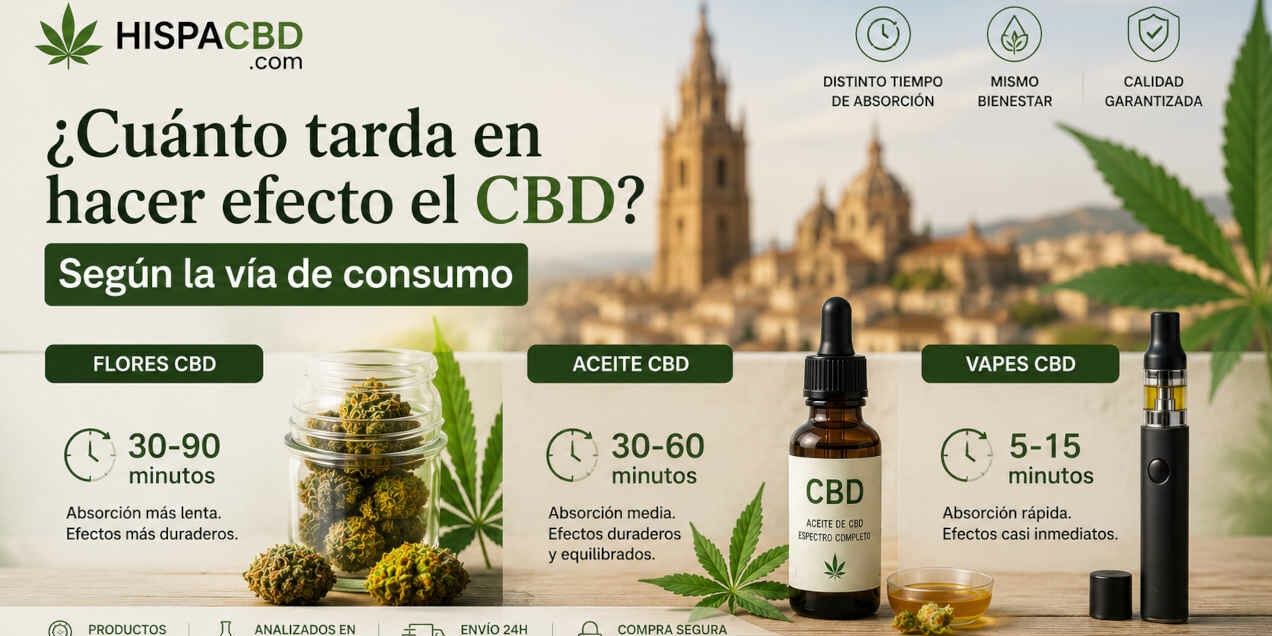
⏱ Onset time: 15 – 45 minutes ⏫ Peak effect: 1 – 2 hours ⏳ Duration: 4 – 8 hours 📊 Bioavailability: 13 – 35%
The sublingual route is the most popular and recommended for regular CBD use. It involves placing a few drops of oil under the tongue and holding them there for 60 to 90 seconds before swallowing.
Why does it work so well? Under the tongue is a dense network of blood capillaries covered by a very thin, permeable mucous membrane. CBD is absorbed directly through this membrane and passes into the bloodstream almost immediately, bypassing the digestive system and liver on its first pass. This avoids what is known in pharmacology as the "first-pass effect," which is the process by which the liver metabolizes and reduces the concentration of a substance before it reaches the general circulation.
The first effects are usually noticeable between 15 and 45 minutes. Peak blood concentration is reached between 1,5 and 2 hours after ingestion, and the duration can extend up to 8 hours depending on the dose and individual metabolism.
Practical tip: Hold the drops under your tongue for at least 60 seconds before swallowing. The longer the contact time with the mucous membrane, the greater the absorption. Swallowing quickly converts a significant portion of the oil into an oral dose, reducing its bioavailability.
Ideal for: daily and regular use, sustained effects throughout the day, stress management or sleep.
2. Oral route (capsules, edibles, swallowed oil): slow but long-lasting
⏱ Onset time: 45 minutes – 2 hours ⏫ Peak effect: 2 – 3 hours ⏳ Duration: 6 – 8 hours (up to 12 hours in some cases) 📊 Bioavailability: 6 – 15%
When CBD is ingested directly—whether in capsules, tablets, infusions, or oil mixed with food—it travels through the entire digestive system before reaching the bloodstream. The process is roughly as follows: stomach → small intestine → liver (first-pass effect) → blood. At each stage, some of the CBD is metabolized and lost, hence the lower bioavailability.
The direct consequence is that the effects take longer to appear—between 45 minutes and 2 hours depending on the person—but they also last longer, because CBD is released gradually as the body processes it. Many people describe the effects of the capsules as milder but more consistent than those of the sublingual oil.
A key factor: diet. Taking oral CBD with a high-fat meal can significantly increase its absorption. CBD is fat-soluble, and dietary fats act as carriers that facilitate its passage into the bloodstream, potentially improving bioavailability considerably.
Practical tip: If you're using capsules or oil orally, take them with a meal that includes healthy fats (avocado, olive oil, nuts). You'll notice a greater effect with the same dose.
Ideal for: people who value comfort and discretion, nighttime use for sleep, those who prefer long-lasting effects without needing to repeat the dose.
3. Inhalation route (vaporized flowers): the fastest
⏱ Onset time: 2 – 10 minutes ⏫ Peak effect: 15 – 30 minutes ⏳ Duration: 2 – 3 hours 📊 Bioavailability: 30 – 50% (vaporization) / 15 – 30% (combustion)
Inhalation is by far the fastest way to consume CBD. When CBD is inhaled as vapor, the molecules pass directly from the alveoli in the lungs into the bloodstream, without any intermediate digestive or hepatic processes. The effect can appear within minutes and reaches its peak at 15-30 minutes.
The bioavailability of vaporized CBD is also the highest of all common routes of consumption: studies place the range between 30 and 50% for vapor, compared to 15-30% for smoke (combustion). The difference is explained by the fact that combustion produces byproducts that interfere with absorption and that flame temperatures destroy some of the CBD.
The downside is that the effects last for a shorter time: between 2 and 3 hours, significantly less than the sublingual or oral route.
Vaporization vs. combustion: If you choose inhalation, vaporization is always preferable to smoking. A vaporizer heats CBD flowers to controlled temperatures (between 170 and 210°C approximately), releasing the cannabinoids and terpenes without combustion, thus eliminating the tars and harmful compounds produced by burning plant material.
Practical tip: If you're looking for a quick effect at a specific moment—sudden tension, difficulty sleeping—inhalation offers the most immediate solution. For a sustained effect lasting for hours, combine it with sublingual administration.
Ideal for: those seeking quick relief in specific situations, people with previous experience using CBD flowers.
4. Topical route (creams, balms, body oils): local action
⏱ Onset time: 20 – 60 minutes ⏫ Peak effect: 1 – 2 hours ⏳ Duration: 3 – 5 hours 📊 Systemic bioavailability: very low (mainly local effect)
Topical CBD products—creams, balms, gels, body oils—work differently than the methods described above. CBD is absorbed through the skin and acts primarily on cannabinoid receptors present in the skin itself, muscles, and underlying connective tissue, without reaching the bloodstream in significant quantities.
This means the effect is local, not systemic . A CBD balm applied to an area of muscle tension may be effective in that specific area, but it won't have the same impact on mood or sleep as a sublingual oil.
The skin acts as a naturally impermeable barrier, limiting the amount of CBD that can penetrate it. Absorption depends heavily on the product formulation (high-quality lipid vehicles improve penetration) and the application area (thinner skin, such as on the wrists or neck, allows for better absorption).
There is also the transdermal route , using special patches designed to allow CBD to penetrate the skin barrier and reach the bloodstream in a sustained manner. This option offers consistent levels of CBD for hours, although it is still not widespread in the Spanish market.
Practical tip: Apply the product with a gentle massage to improve local circulation and promote absorption. To enhance the effect, keep the area covered with clothing for a while.
Ideal for: localized muscle and joint pain, skin care, post-exercise sports recovery.
Comparative table: summary by consumption route
| Consumption route | Start of the effect | Maximum effect | Duration | Bioavailability |
|---|---|---|---|---|
| Sublingual (oil under the tongue) | 15 - 45 min | 1 - 2 h | 4 - 8 h | 13 - 35% |
| Oral (capsules, edibles) | 45 min – 2 h | 2 - 3 h | 6 - 12 h | 6 - 15% |
| inhalation (vaporization) | 2 - 10 min | 15 - 30 min | 2 - 3 h | 30 - 50% |
| Topical (creams, balms) | 20 - 60 min | 1 - 2 h | 3 - 5 h | Very low (local) |
What if I don't notice anything? The most common reasons
If you've tried CBD and haven't noticed any effect, before concluding that "it doesn't work," it's worth reviewing these factors:
1. Insufficient Dosage This is the most common reason. CBD doesn't work the same for everyone, and the correct dosage varies greatly from person to person depending on weight, metabolism, and goals. Starting with very low doses is the most prudent approach, but if you don't notice any difference within two weeks, you may need to increase the dosage gradually.
2. You swallowed the oil too quickly. If you use sublingual oil but swallow it before it's absorbed, you're turning a sublingual dose into an oral one, resulting in reduced bioavailability and a delayed effect. Keep the drops under your tongue for at least 60 seconds.
3. An empty (or overly full) stomach: For capsules and oral oil, taking CBD on a completely empty stomach can reduce absorption. Consuming healthy fats at the same time significantly improves bioavailability.
4. Product Quality. Not all CBD products on the market have the concentration indicated on the label. Independent laboratory analyses (COAs) are the only guarantee that a product truly contains what it claims. At HispaCBD, all our products have certificates of analysis verified by external laboratories.
5. Unrealistic Expectations: CBD doesn't produce an immediate and obvious effect like a conventional painkiller or THC. Its action is more subtle: many people describe it as an absence of what was bothering them—more calm, less tension—rather than an active and intense sensation. Especially in the first few weeks of use, the effect can be difficult to identify. Consistency is key.
6. The cumulative effect. Some effects of CBD—especially those related to sleep or mood—are more noticeable with continued use over several weeks than with occasional doses. The endocannabinoid system responds gradually to the regular supply of external cannabinoids.
Which route is best for me?
There is no universal answer, but there are some practical guidelines:
- If you're looking for sustained overall effects (daily well-being, sleep, stress) → sublingual oil, due to its balance between speed, bioavailability and duration.
- If you value comfort and don't want to think about it → capsulesalthough it may take longer to notice the effect.
- If you need quick relief at a specific time → steamed flowerswith effect in minutes.
- If you have a specific area with tension or discomfort → topical cream or balm applied directly.
- If you are new to CBD → Start with 5% or 10% sublingual oil, as it offers the best balance between dose control, speed and duration of effect.
Conclusion
The question “how long does it take for CBD to take effect?” has an answer that ranges from 2 minutes (vaporization) to 2 hours (oral capsules). The key is not just waiting, but understanding which method you're using, its bioavailability, and what to expect from it.
Choosing the right method of consumption is just as important as choosing the right dose or concentration. And if one thing is clear, it's that patience and consistency are fundamental to any CBD use protocol.
At HispaCBD you'll find CBD flowers, resins, oils, and topical products with verified lab analysis, THC content below 0,2%, and 24-48 hour delivery throughout Spain. If you have any questions about which product best suits your needs, our customer service team is available via WhatsApp for personalized guidance.
Disclaimer: This article is for informational purposes only and does not constitute medical advice. Always consult a healthcare professional before starting any CBD protocol, especially if you are taking other medications.
Frequently asked questions (FAQ)
Can I take CBD in multiple ways at once? Yes. Many users combine methods depending on their needs: for example, sublingual oil in the morning for general well-being and a topical cream for muscle relief after exercise. There are no incompatibilities between the different ways of using CBD.
Why do I sometimes feel the effects of CBD and sometimes not? Variability from day to day is normal and is due to factors such as whether you've eaten, your stress level, hydration, prior rest, and slight differences in the dosage. Regular use and consistent intake will help you achieve more consistent results.
Is taking CBD at night different than in the morning? CBD doesn't categorically have a stimulant or sedative effect on its own, but many people perceive it as more relaxing at moderate to high doses. At low doses, some find it mildly energizing. The experience is highly individual. It's best to experiment at times that best suit your needs and observe how your body responds.
Does CBD accumulate in the body with daily use? CBD is fat-soluble and can accumulate to some extent in adipose tissue with regular use. This can make the effects more noticeable over time and result in a longer half-life of CBD in the body for regular users compared to those who use it only occasionally.
How much CBD should I take the first time? As a general starting point, 10-20 mg per day (divided into 1-2 doses) is a reasonable range to begin with. From there, adjust gradually based on your response. There is no single dose that works for everyone.