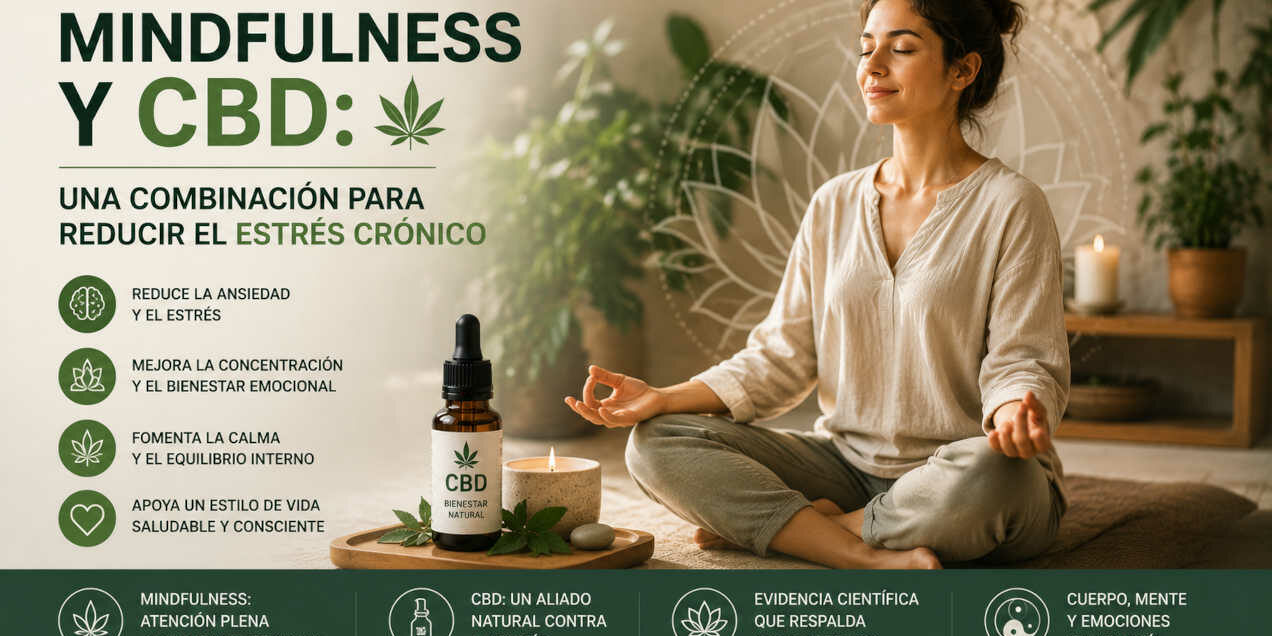
Mindfulness is a practice of paying attention to oneself with centuries of history and, in recent decades, a growing body of research. CBD has been added to that conversation as a purported calming enhancer.
Here we explain what evidence supports mindfulness, what is known about CBD, and why mixing them does not multiply the evidence.
What is mindfulness and what is not
Mindfulness is paying attention to the present moment intentionally and without judgment. It's not about relaxing or emptying your mind: it's about training your attention.
Structured programs, such as MBSR, have defined protocols and have been studied in clinical and work contexts.
-
Beldia CBN
From 8.00€ -
Black Butter
From 8.00€ -
Casablanca
From 8.00€ -

CBD Isolate 99%
From 5.00€ -
Caramel Cola
From 8.00€ -
Crumble Jack Herer
Price range: from €6.40 to €116.00 VAT incl. -
double 0
From 8.00€ -
Dry Ice
From 8.00€ -
dry sift
From 8.00€ -
Ketama Gold
From 8.00€







What does the evidence say about mindfulness?
Reviews have found small to moderate effects on perceived stress, anxiety, and well-being, with varying quality depending on the study. It's not a cure, but it has more support than most supplements.
Consistent practice matters: the effects appear with weeks of training, not with a single session.
What the evidence says about CBD
Evidence on CBD and stress is limited: small studies, mixed results, and few high-quality trials. There is no data to suggest that it enhances mindfulness.
Adding two interventions with limited evidence does not magically produce solid evidence.
Why the combination is appealing
Marketing finds in mindfulness a friendly language and in CBD a product to sell. Together they form a coherent narrative: “conscious calm.”
The problem is that the narrative replaces the facts. If the practice works, it works without a product; if it doesn't work, the product won't fix it.
How to practice without spending money
Start with short breath awareness sessions, use free apps or public guides, and be consistent. Informal practice—walking, eating, or mindful listening—also counts.
If you're looking for a structured program, the eight-week MBSR is the most studied.
When stress needs something more
If the discomfort interferes with your daily life or persists, practice alone may not be enough. In that case, psychological therapy and medical evaluation are the appropriate next steps.
Mindfulness is a tool, not a substitute for treatment.
What we do
We do not present CBD as a performance enhancer or a stress treatment. We publish its composition and analysis, and nothing more.
How to get started in ten minutes a day
Sit with your back straight, close your eyes or lower your gaze, and focus on your breath. When your mind wanders—and it will—bring it back without judgment. Ten minutes a day for two weeks is a good starting point.
Consistency matters more than duration. It's better to practice for ten minutes every day than for an hour once a month.
Common Mistakes
Believing that you have to empty your mind, demand immediate results, or give up because thoughts arise is a misconception. Thoughts are part of the practice: what you train is the return to focused attention.
It is also a mistake to use mindfulness practice to avoid a problem that needs treatment. Mindfulness is not a substitute for therapy.
Informal practice
Walking mindfully, eating without screens, or listening to a conversation without preparing a response are all forms of informal practice that fit into any routine.
Mindfulness at work
Taking one-minute breaks between tasks, listening without interrupting, or focusing on breathing before a meeting are informal practices that reduce reactivity.
They do not replace improving working conditions, but they help manage the stress response while those conditions are being changed.
What science says about compassion and care
Mindfulness programs include practices of both attention and compassion. Reviews find small to moderate effects on stress and well-being, with considerable variability between studies and methodological difficulties. It's not magic, but it's not a mirage either.
The quality of the instructor, the program's duration, and personal practice all influence the outcome. An eight-week course is not the same as an app that's opened twice. The evidence refers to structured programs, not just anything called mindfulness.
That's why it's wise to be wary of anyone who promises immediate results or attributes them to a product. Sustained practice is what produces change, and those changes are modest.
A practice, not a product
Mindfulness is cultivated through repetition, not purchased. That's both its advantage and its challenge: it demands time and consistency, and doesn't offer the immediate gratification of a purchase. However, its scientific backing is stronger than that of most trendy supplements.
If you're looking to get started, choose a structured guide and practice for ten minutes a day for two weeks before deciding if it's right for you. And if the discomfort is severe, combine it with professional help.
You can read more about terpenes and aroma and about the legal framework of CBD.
Practice works best when integrated into your routine, not when used as a one-off rescue. Ten minutes a day, every day, is worth more than one long session every two weeks. And it doesn't require buying anything.
If after several weeks you don't notice anything, don't blame yourself or buy a supplement: change your guide, reduce the demands, or consult a professional who can guide you.
Sources and transparency
This article summarizes peer-reviewed literature and public documents from the European Medicines Agency and the Spanish Agency for Medicines and Health Products. It is not a systematic review or medical advice. Statements may change as new studies are published; if you find an error, please let us know and we will correct it.
FAQ
Does CBD improve mindfulness?
There is no evidence to prove it.
Is mindfulness helpful for anxiety?
It has moderate support in structured programs, not in individual sessions.
Do I need a product for meditation?
No. The practice does not require supplements.
How long does it take for the practice to take effect?
Weeks of constant practice, according to studies.
Contact
WhatsApp 623 18 92 54 , Monday to Friday. Questions about composition, formats or documentation.