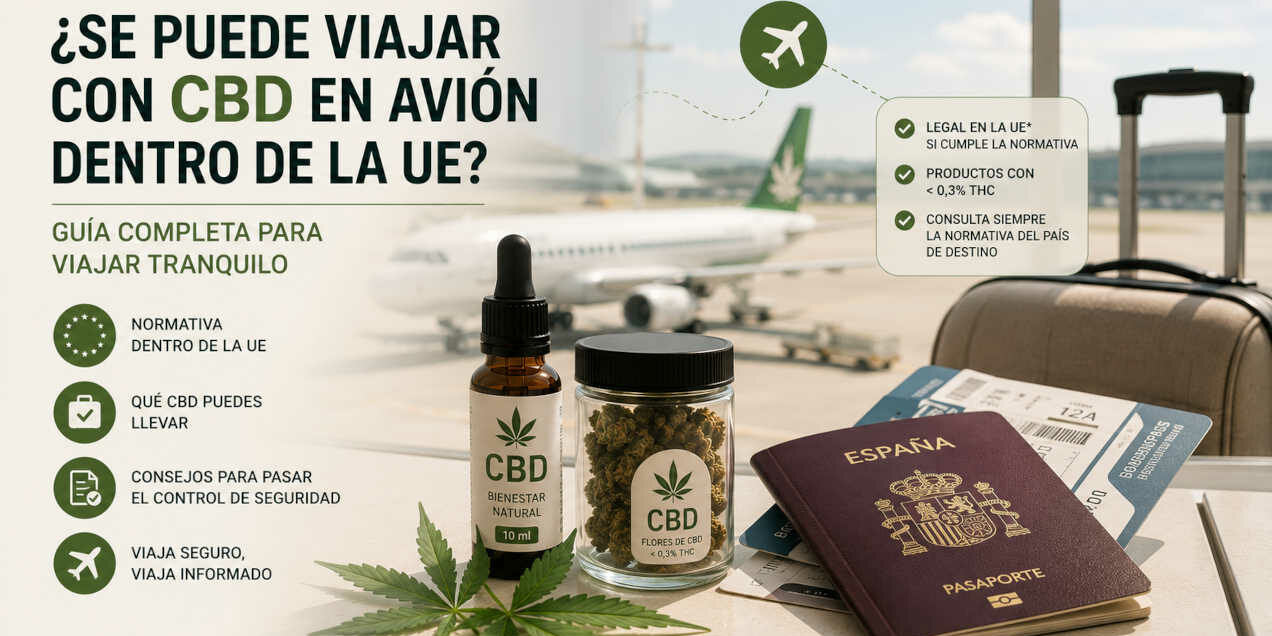
You've been taking your CBD oil every night for weeks and don't want to interrupt your routine during your vacation. Or perhaps you have a business trip and CBD is already part of your regular wellness kit. The question is legitimate, and the answer is more complex than many expect: yes, you can travel with CBD by plane within the EU, but with very specific conditions that you should be aware of before packing your suitcase.
The fact that the EU has moved towards a common position on CBD—strengthened by the 2020 ruling by the Court of Justice of the EU that declared CBD cannot be considered a narcotic—does not mean that all member states apply exactly the same rules. And at the airport, a traveler's experience can vary significantly depending on the product they are carrying, how they are carrying it, and where they are going.
In this guide we explain everything you need to know to travel with CBD within the EU with maximum peace of mind and without unpleasant surprises.
The starting legal framework: what the EU says about CBD
The starting point is favorable. CBD is protected at the EU level by the 2020 Kanavape ruling of the Court of Justice of the European Union (case C-663/18): member states cannot prohibit CBD legally produced in another EU country. This ruling is fundamental because it establishes that CBD derived from industrial hemp, legally produced in one member state, must be able to circulate freely between EU countries like any other product in the single market.
In practice, this means that CBD oil legally purchased in Spain—with less than 0,2% THC and properly labeled—is legally permitted to be transported to another EU country. However, there is a crucial caveat: the final decision on whether you can travel with your products always rests with the individual security official.
CBD is not on the controlled substances list of most European countries, airport security officers do not actively search for CBD, and the likelihood of an incident is low when the product is properly documented. But variability exists, and preparing for it is key.
Which products can you bring and which pose the greatest risk?
Not all CBD forms carry the same level of risk in safety controls. It's important to know the differences:
✅ CBD oils: the safest format
Oils and capsules are generally the least problematic forms of CBD at security checkpoints. Their discreet appearance raises less suspicion than CBD flowers.
CBD oil in its original packaging, with clear labeling that includes the CBD and THC concentrations, and accompanied by a laboratory analysis certificate, is the product with the lowest risk of causing problems at the airport. Visually, it is indistinguishable from any other oil or natural supplement, and security personnel are accustomed to seeing these types of products.
Liquid Regulations: CBD oils are subject to general hand luggage liquid regulations. Historically, these regulations limited containers to 100 ml and required a 1-liter transparent bag. <cite index=”272-1″>From 2025 and 2026, European airports are installing new-generation scanners that accurately identify the contents of each container, allowing travelers to carry liquids of up to 2 liters per container without removing them from their luggage. However, the regulations are not yet universal: if the airport does not have the new scanners, you must still follow the 100 ml rule.</cite>
Practical recommendation: Check the departure airport before traveling. If you have any doubts, carry the oil in a 10 or 30 ml bottle—the most common sizes on the CBD market—which will meet the 100 ml limit without you having to worry about it.
✅ Capsules and tablets: no liquid restrictions
CBD capsules are not subject to liquid regulations and can be carried in hand luggage without quantity restrictions, just like any other supplement. They are the most convenient and discreet format for travel, although they have the disadvantage of a slower onset of effect.
✅ Creams and cosmetics with CBD
CBD cosmetics—creams, balms, serums—are regulated by the European Cosmetics Regulation and have the clearest legal framework within the EU. They are subject to the regulations for liquids if they exceed 100 ml, but they do not raise any concerns in safety controls when they are correctly labeled.
⚠️ CBD flowers and resins: the most delicate format
CBD flowers should not be carried on airplanes due to their similarity to marijuana. This is the most unanimous advice among cannabis legality experts, and it deserves full attention.
Visually, a CBD flower is indistinguishable from a high-THC cannabis flower. Airport X-ray scanners also cannot determine the THC content of a sample. If an officer detects cannabis flowers—regardless of the THC percentage—they can retain them for analysis, which at best results in a waste of time and the confiscation of the product, and at worst, a legal complication in countries with stricter legislation.
The clear recommendation is: do not bring CBD flowers or resins on the plane, not even within the EU. If you need them at your destination, buy them there.
⚠️ CBD vapes
You can travel by plane with CBD vapes as long as you meet certain very specific conditions. You must carry the vape in your hand luggage, never in your checked baggage. The vape's contents must be in their original packaging. The cartridge's e-liquid must not exceed 100 ml and must be transported in a 1-liter transparent bag along with other liquids. Vaping is not permitted on the plane or in any unauthorized areas within the airport.
Vaping devices must always be carried in hand luggage due to their lithium batteries (international aviation regulations). CBD e-liquid in cartridges or bottles is subject to the airport's liquid regulations.
The essential documentation
If you're traveling with CBD, having the correct documentation can make the difference between a smooth interaction with security agents and an uncomfortable situation.
Certificate of Analysis (COA) from the laboratory
The most important document you should bring is the Certificate of Analysis (COA) from an external laboratory. This certifies the exact concentration of cannabinoids, especially THC.
The Certificate of Analysis (COA) must be a document issued by an independent laboratory—not the manufacturer—that shows the levels of CBD, THC, and other cannabinoids in the specific batch you are carrying. Download the digital version to your mobile device or bring a printed copy.
The product in its original packaging
Never transfer CBD oil or capsules to another unlabeled container. The original container with complete labeling—product name, concentration, manufacturer, and lot number—is the first identifying element an officer will use to assess what you are carrying.
Invoice
A receipt or invoice from the store where you purchased the product, showing that it is a legal CBD product acquired from an authorized store, is a useful additional support, especially if you are carrying several products or larger quantities.
Print out the information if you are traveling to countries less familiar with CBD.
It can be helpful to print out the latest information to show to security personnel who may not be familiar with the details. Especially in airports in Eastern or Northern European countries where the CBD market is less developed, agents may not be familiar with the difference between CBD and illegal cannabis.
Differences between EU countries that you should know
Although the Kanavape ruling establishes the principle of free movement of CBD within the EU, each member state applies its own rules in practice. These are the most relevant differences for a Spanish traveler:
THC limits by country
CBD is generally fine to carry within the EU if the product remains below the national THC threshold — 0,2% in most countries, 0,3% in Germany and the Czech Republic.
A Spanish product with 0,2% THC complies with the limit in all European countries where CBD is permitted, including Germany (0,3%) and the Czech Republic (0,3%), which apply a higher threshold. Switzerland is a notable exception, allowing up to 1% THC. However, Switzerland is not an EU member, and crossing its border with CBD technically means leaving the Schengen Area for customs purposes for certain products.
Germany: the most permissive since 2024
Germany legalized recreational cannabis in April 2024. Adults can possess up to 25 grams in public. This makes it one of the most permissive European countries: you won't be fined for carrying CBD within the country. Traveling with CBD from Spain to Germany or vice versa—both intra-EU flights—presents no additional complications as long as the product meets the THC limits.
France: oils and cosmetics yes, flowers no
In France, CBD oils and cosmetics are legal if they contain less than 0,3% THC. However, France has historically been more restrictive with CBD flowers—which it even banned in 2021 before the Council of State halted the ban—and in practice, security personnel may be more cautious with any product that visually resembles cannabis. Oils and capsules are generally not a problem; flowers and resins are best left alone.
Italy: changing situation in 2025-2026
Italy is a notable case, as its regulations are undergoing significant changes. In April 2025, a decree banned CBD flower products, and although the Consiglio di Stato suspended it in December 2025, the situation remains unresolved, with a final ruling expected in May 2026. The recommendation is clear: do not bring CBD to Italy, and if you need it, buy it there.
For oils, cosmetics, and capsules, Italy remains generally permissive. However, CBD flowers in hand luggage to Italy pose a real risk in 2026, given that the legal situation remains contentious.
Northern and Eastern European countries
Countries like Sweden, Finland, Norway (non-EU), and some Baltic states apply stricter criteria. Sweden, Finland, and countries in Northern and Eastern Europe may also apply stricter criteria. In these destinations, extra caution is warranted: always carry the Certificate of Auth and the original packaging, and limit yourself to oils or capsules.
What happens at airport security?
Understanding how airport security controls work helps to gauge the actual risk:
Security personnel look for threats to flight safety, not drugs. The primary function of security screening is to detect explosives, weapons, and dangerous objects, not illegal substances. Drugs are primarily searched for by trained dogs from law enforcement (police or civil guard), who operate in areas separate from regular baggage screening.
X-ray scanners don't detect CBD. What they detect is the density and shape of objects. A bottle of CBD oil appears like any other bottle of oil. A block of resin might produce an image that looks more like something that warrants manual inspection, which is another reason not to bring flower or hash on a plane.
If you are asked to open your luggage , remain calm and show the product in its original packaging with the Certificate of Analysis (COA). Calmly explain that it is legal CBD with less than 0,2% THC. The vast majority of agents, upon seeing the documentation, have no objection. <cite index=”276-1″>In countries where CBD is legal or not considered a controlled substance, airport staff will have no reason to search for it.</cite>
Flights with layovers: the additional factor to consider
If your flight includes a layover in a third country—outside the EU—the situation becomes more complicated. The rules of the transit country apply even if you don't intend to leave the airport, because in most cases you'll go through security at the layover airport.
A layover in Turkey, the United Arab Emirates, Singapore, or Japan—for example, on a flight from Spain to an Asian destination—can pose a serious problem if you are carrying CBD, as these countries have very strict laws that include CBD regardless of its THC content.
For purely intra-EU flights without stopovers in third countries , this risk does not exist.
Airline rules: a factor that few people consider
In addition to airport and national regulations, each airline may have its own policy regarding the transport of CBD products. Most European airlines do not have specific policies on CBD—treating it like any other supplement or cosmetic—but some, especially low-cost carriers with stricter regulations on what can be carried on board, may have restrictions.
If you're flying with CBD products, check the specific airline's regulations to avoid problems at airport security. Also, keep in mind that the rules in your destination or transit country may differ from your carrier's policy—and vice versa. Always follow the strictest rules.
Summary table: what you can bring and how
| Product | Hand luggage | Checked baggage | Recommended documentation |
|---|---|---|---|
| CBD oil (≤100 ml) | ✅ Yes (liquids bag or new scanner) | ✅ Yes | COA + original packaging |
| CBD oil (>100 ml) | ⚠️ Only with a new CT scanner | ✅ Yes | COA + original packaging |
| CBD Capsules | ✅ No restrictions | ✅ Yes | COA + original packaging |
| CBD cream/cosmetic (≤100 ml) | ✅ Yes (liquid bag) | ✅ Yes | correct labeling |
| CBD Vape | ✅ Yes (lithium battery: handheld only) | ❌ No (lithium battery) | COA + invoice |
| CBD flowers | ❌ Not recommended | ❌ Not recommended | |
| CBD resins/hash | ❌ Not recommended | ❌ Not recommended |
Table by country: approximate risk for Spanish travelers with CBD
| Destination country | Legal THC limit | Oils/capsules | Flowers/resins | Comments |
|---|---|---|---|---|
| Germany, | 0,3 % | ✅ No problem | ⚠️ Caution | Legal recreational cannabis from 2024 |
| France | 0,3 % | ✅ With COA | ❌ Not recommended | More restrictive historical with flowers |
| Italy | 0,2 % | ✅ With COA | ❌ Not recommended | Legal status of flowers in litigation in 2026 |
| Portugal | 0,2 % | ✅ No problem | ⚠️ Caution | Generally tolerant stance |
| Netherlands | 0,2 % | ✅ No problem | ⚠️ Caution | Regulatory gray area on CBD |
| Czech Republic | 0,3 % | ✅ With COA | ⚠️ Caution | Highest THC Threshold |
| Sweden / Finland | 0,2 % | ⚠️ With COA | ❌ Not recommended | Stricter criteria |
| Austria | 0,3 % | ✅ With COA | ⚠️ Caution | CBD is freely available |
| Belgium | 0,2 % | ✅ With COA | ⚠️ Caution | |
| Poland | 0,2 % | ⚠️ With COA | ❌ Not recommended | More conservative policy |
7 practical tips for traveling with CBD without problems
1. Download your product's COA before leaving. Save it on both your mobile device and email so you can access it offline.
2. Keep the product in its original packaging. Never transfer it to another container. The labeling is your first line of defense.
3. Forget about bringing flowers and resins on the plane. The risk-benefit ratio isn't worth it. Buy them at your destination if you need them.
4. Carry the oils in 10-30 ml bottles. You meet the 100 ml rule effortlessly and reduce the volume you have to manage.
5. Vape devices must always be carried in hand luggage. Lithium batteries are prohibited in checked baggage without exception.
6. Check the specific situation of the destination country. Especially for Italy, Sweden, Finland, and Eastern European countries.
7. If you are stopped, stay calm and show your documentation. There is no crime you can be charged with for carrying legal, properly documented CBD within the EU.
What if I have doubts about a specific destination?
If you're traveling to a country you're unsure about, these are the most reliable sources to check the current situation:
- The official website of the embassy or consulate The destination country may have information on controlled substances.
- The airline, which has an obligation to inform you about what you can bring on board.
- The destination airportwhose website usually has sections about prohibited items.
Remember that information online may be outdated. CBD regulations in Europe changed significantly between 2024 and 2026 and will continue to evolve. Always follow the strictest rules when airline and destination country regulations differ.
Conclusion
Traveling with CBD by plane within the EU is perfectly viable and legal for properly documented oils, capsules, and cosmetics . The 2020 Kanavape ruling establishes the principle of free movement of CBD within the European area, and in practice, airport security does not actively search for these types of products when they are properly labeled and accompanied by a certificate of analysis.
The real risks are twofold: CBD flowers and resins—which are visually indistinguishable from illegal cannabis and should never be carried on a plane—and countries with more restrictive legislation, especially Italy in 2026 and the countries of northern and eastern Europe.
The key to a smooth trip is simple: use the product in its original packaging, keep the Certificate of Auth on your phone, pack the oil in a small bottle in your liquids bag, and buy flowers at your destination if needed. With that, the risk of problems is minimal.
At HispaCBD, we ship throughout Spain in 24-48 hours. If you're traveling soon and want to stock up before you leave with products that have a Certificate of Analysis (COA) available by batch and the correct labeling for any inspection, check out our catalog or contact us via WhatsApp.
Disclaimer: This article is for informational purposes only and does not constitute legal advice. CBD regulations vary by country and may change. Always check the current legislation in your destination country before traveling.
Frequently asked questions (FAQ)
Do I need to declare CBD at the airport? There is no obligation to actively declare it, but it must go through the security scanner along with the rest of your carry-on luggage. If asked what it is, show the original packaging and the Certificate of Auth (COA). You don't need to proactively remove it from your bag unless the agent asks you to.
Can my CBD oil be confiscated at an EU airport? Technically, if the product complies with the THC limit of the destination country and is correctly labeled, there should be no legal basis for confiscation. However, in practice, the officer's decision is final at the time of inspection. That's why documentation is crucial: with a Certificate of Analysis (COA) showing the THC content below the legal limit, any complications can be resolved quickly.
Can I bring more than one CBD product? Yes. There is no specific quantity limit for legal CBD products when traveling within the EU. Bringing multiple oils, creams, and capsules is perfectly reasonable as long as they all have correct labeling and a Certificate of Analysis (COA), and the total quantity is consistent with personal use.
What if I fly with Ryanair, EasyJet, or other low-cost airlines? Low-cost airlines apply the same security rules as full-service airlines, as these rules are determined by airports and local authorities, not the airline itself. They may have their own policies regarding what to bring on board, but for properly documented CBD products, there are generally no additional restrictions compared to other airlines.
Is full-spectrum CBD with 0,2% THC riskier to carry than isolate? From a legal standpoint, no: both are within the permitted limit. From a practical standpoint, also no: the Certificate of Auth (COA) for both will show the THC content below 0,2%. What does matter is that the COA is visible and verifiable, regardless of the spectrum type.